Imagine you’re teaching Ancient Egypt and one of your pupils wants to know what it actually felt like to be a child living thousands of years ago.
Normally, you’d reach for a book, search online or explain it yourself.
But what if they could simply ask an Ancient Egyptian?
That’s the idea behind AI avatars in schools — and it’s something we’ve started using at Giant Journeys to turn history lessons into two-way conversations.
What are AI avatars in schools?
An AI avatar is a digital character that pupils can speak to in real time.
But there’s an important distinction.
We’re not simply putting ChatGPT on a big screen and asking it questions.
Our avatars have identities, personalities and historical settings. Children meet a character from the period they’re studying and can talk directly to them, using their own questions to uncover information and solve challenges.
Suddenly, history isn’t just something that happened.
It’s someone you can talk to.
Meet the historical characters already visiting schools
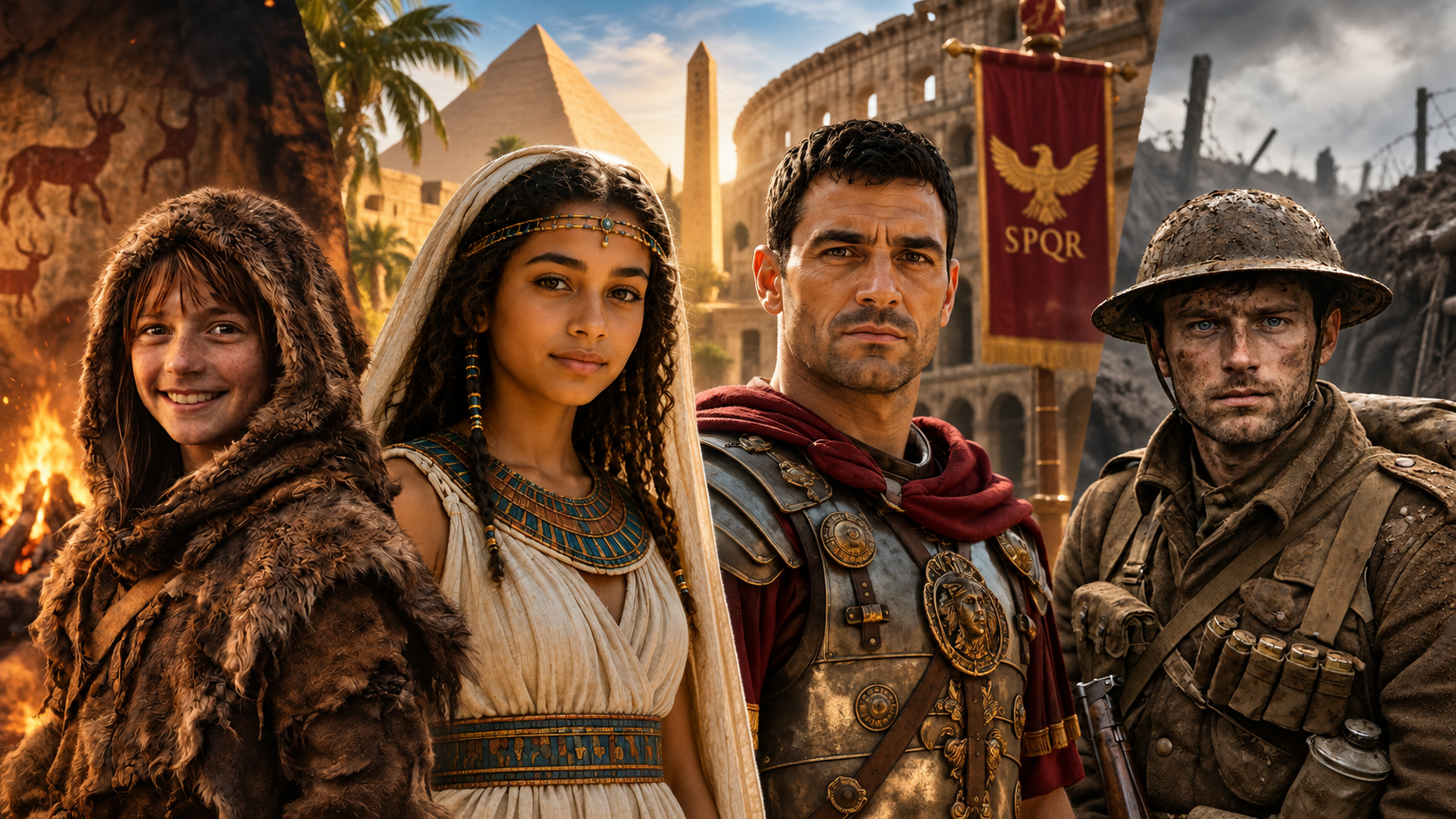
Our AI avatar school workshops currently take children into four very different periods of history.
Taki – a Stone Age Journey
What would you eat? Where would you sleep? And what happens when something important goes missing?
Children meet Taki before exploring a prehistoric environment and helping solve a Stone Age mystery.
Amina – an Ancient Egypt Journey
Amina takes pupils into Ancient Egypt, where they can explore a virtual Egyptian environment and question her about the world she lives in.
The clever bit is that pupils aren’t simply being given the answers. They need to work out which questions might uncover the information they need.
Marcus – a Roman Centurion’s Journey
Marcus brings Roman Britain to life while pupils explore an interactive Roman environment, investigate clues and learn about Roman life.
Rather than reading what a Roman soldier might say, they can ask one.
Tommy – a World War One Journey
Our WW1 experience introduces pupils to Tommy and challenges them to help him on his journey home.
Along the way, children can explore CGI environments including a First World War trench and recruitment office, combining conversation, investigation and historical learning.
AI avatars in schools aren’t really about AI
This might sound strange coming from a company using AI.
But the technology isn’t the most interesting bit.
The questions are.
There’s an understandable concern that AI could make things too easy for children. Ask a machine a question, receive an answer, job done.
We’re trying to use it differently.
Instead of replacing thinking, the AI character can reward curiosity.
If children want to discover something, they have to decide what to ask. They can follow an answer with another question. They can test an idea. And sometimes, they discover something that sends the whole conversation in an unexpected direction.
That’s much closer to how children naturally learn.
What happens when you give history a voice?
There is another important ingredient.
Our characters don’t exist in isolation.
We’ve created bespoke digital environments for children to investigate alongside them.
One moment they might be talking to Amina. The next, they’re exploring Ancient Egypt.
They can meet Marcus before navigating the Roman world, or talk to Tommy while investigating the surroundings of the First World War.
The AI gives history a voice. The interactive environment gives it somewhere to live.
And that’s when something interesting happens.
The lesson starts feeling less like learning about history and more like stepping inside it.
Can AI avatars make history more memorable?
That’s ultimately the question that matters.
A flashy piece of technology isn’t much use if children don’t learn anything from it.
What we’re seeing in schools is that combining conversation, investigation and storytelling gives pupils several different ways to engage with the same topic.
Some children love questioning the character.
Others want to explore.
Some become completely absorbed in solving the challenge.
And those moments can become useful starting points for classroom work afterwards.
Where could AI avatars in schools take us next?
We’re only getting started.
Next to join our historical line-up will be Alexios, taking children into Ancient Greece, and Pip, a young Victorian newspaper seller.
And there are plenty more ideas in development.
That’s what makes this technology particularly exciting for us.
Not because AI can replace teachers. It can’t.
But because, used creatively, it can give teachers something that wasn’t previously possible:
a classroom where a child can put their hand up and ask history a question.
Bring history to life at your school
Our AI Live Avatar Journeys combine live AI conversation, historical investigation, interactive CGI environments and problem-solving in one immersive school workshop.
If you’re planning a history topic and fancy giving your pupils someone rather unusual to interview, take a look at our AI Live Avatar Journeys and discover which historical character could be visiting your school next.