Leonardo da Vinci spent years drawing the human body from the outside. Yet he wrote “The human body is a machine,” and VR finally lets children see that machine in action.
Picture this: it’s 1628. William Harvey, an English physician with more curiosity than social grace, is about to publish a theory that will nearly end his career. His crime is simple. He suggested that blood doesn’t disappear after every heartbeat. It circulates.
It sounds obvious now, but at the time most doctors believed the liver produced fresh blood every day and the body simply “used it up.” When Harvey ran the numbers, he realised this would require hundreds of pounds of new blood every hour. Impossible. The only logical conclusion was that blood looped around the body, driven by the heart.
He was right, but he couldn’t show it. He had logic, diagrams, and animal experiments. What he didn’t have was a way to make the invisible visible. People refused to believe what they couldn’t see.
Imagine knowing you’re right and still being ignored. Harvey spent his life wishing he could shrink down, float through an artery, and prove it once and for all.
Nearly 400 years later, VR can finally do exactly that. When we teach the human body in primary schools, we still expect children to believe in things they can’t actually see. VR changes that completely.
Why Traditional Human Body Lessons Struggle to Engage
Teachers know that even the best diagrams and plastic models only go so far. We tell children their hearts beat 100,000 times a day, that blood travels 12,000 miles, and that stomach acid can dissolve metal. Yet they can’t picture any of it.
It’s like teaching someone to swim by handing them a diagram of water. The facts sound impressive, but they stay abstract. Information sits in a notebook instead of landing in a child’s imagination.
The Visualization Revolution in Primary Science Education
The most memorable science moments don’t come from memorising organs. They come from seeing how the body works. They come from making the invisible visible, something Harvey could only dream of.
If Harvey had a VR headset, he would have silenced every critic. No lectures. No arguments. Just: “Put this on and watch.” Within seconds, anyone could have raced through arteries and watched valves open and close in perfect rhythm. Seeing really would have been believing.
Now imagine giving that same experience to a Year 5 class.
Journey Through the Circulatory System Like Blood Cells
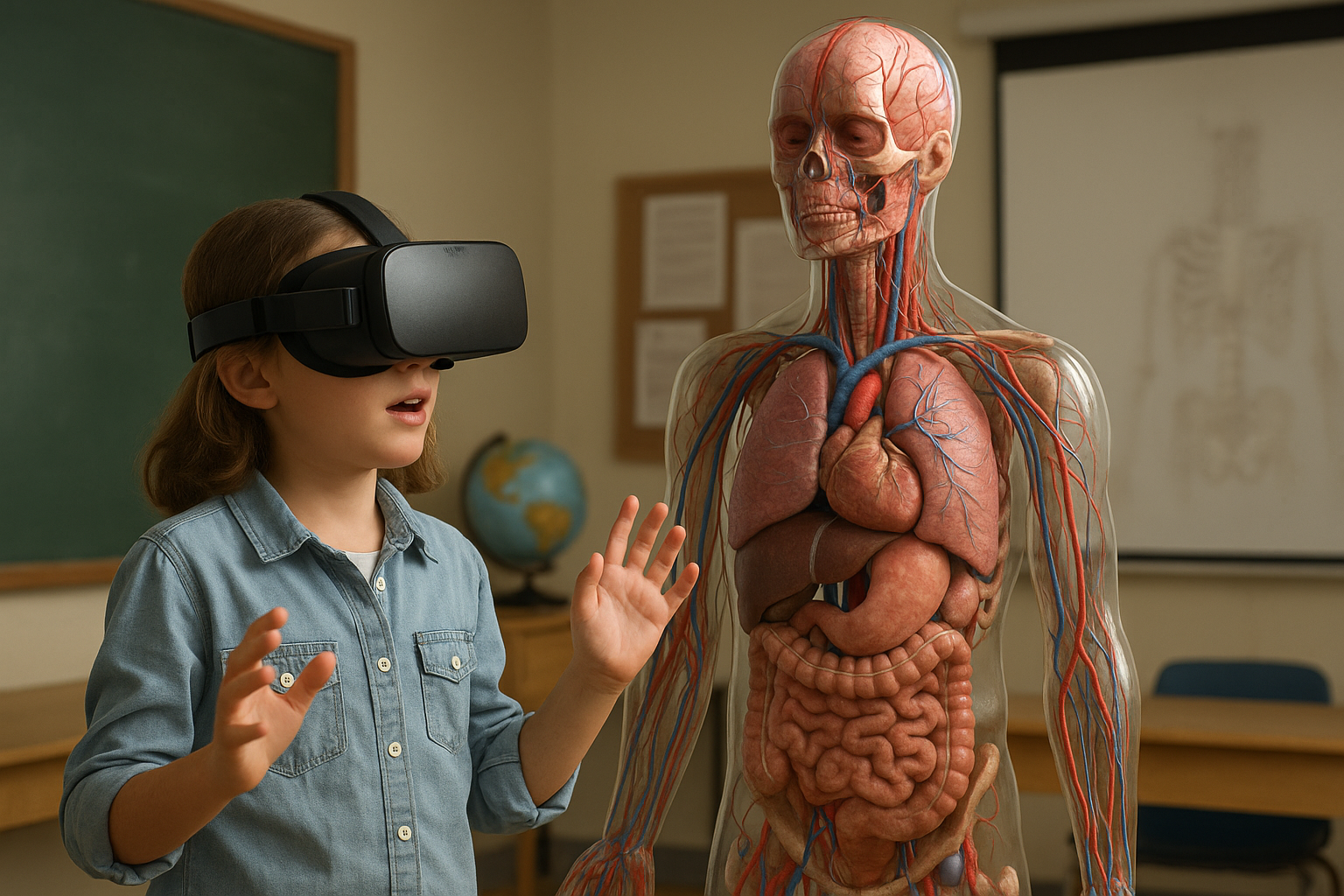
Students shrink to microscopic size and rush through their own bloodstream. They watch red blood cells carrying oxygen and white blood cells patrolling for invaders. They see heart chambers pulsing with life. Suddenly, “100,000 beats a day” becomes something they feel, not just something they hear.
Watch Digestion From the Inside Out
Instead of reading about enzymes and acids, pupils slide down the oesophagus and drop into the stomach. They travel through twenty feet of intestines, watching nutrients get absorbed. It’s fascinating, slightly gross, and completely unforgettable.
Experience the Respiratory System in Real Time
Inside the lungs, children see millions of alveoli expanding and contracting. They watch oxygen merging into the bloodstream and carbon dioxide leaving. Breathing stops being “air in, air out.” It becomes a microscopic ballet happening every second.
Witness the Scale of Internal Processes
Nothing teaches scale like racing through miles of blood vessels or watching thousands of red blood cells float by every second. VR turns impossible numbers into concrete experiences.
What Makes Human Body Education Engaging for Key Stage 2
VR taps into the same curiosity that drove Harvey to challenge 1,500 years of medical dogma. Children already want to understand how things work. Many take apart toys, bikes, even TV remotes. Their own bodies should be the most fascinating machines of all.
When primary schools bring immersive VR into STEM workshops, they aren’t just adding technology. They’re changing how students relate to themselves. Children stop seeing the body as something they have and start seeing it as something they are. A living machine performing thousands of miracles every second.
Even reluctant learners, the ones who drift off the moment a textbook appears, come alive when they’re standing inside a beating heart or drifting through a lung. A topic they once found dull becomes an adventure.
The Secret to Creating Lifelong Science Curiosity
When students step out of a VR headset after exploring the human body, they’re different. They look at their arm and know that beneath the skin, rivers of blood move through thousands of vessels. They feel their breathing and understand the microscopic exchange happening in their lungs. Their heart stops being “an organ” and becomes an engine.
That sense of wonder is what fuels lifelong curiosity. It’s not just about learning facts. It’s about experiencing them.
Harvey would have loved this technology. He spent a lifetime trying to show people what we can reveal in minutes. That’s what these STEM workshops offer: the thrill of discovery that has driven science forward for centuries.
Giant Journeys Inside the Body VR Workshop
Journey Through the Body’s Systems Like Never Before
Transform your Key Stage 2 science lessons into an unforgettable journey through the human body. This immersive VR experience shrinks students down and sends them through the circulatory, respiratory, and digestive systems. They don’t just learn about anatomy. They experience it.
Through cutting-edge VR, pupils witness biological processes happening right before their eyes. It’s the difference between reading about how the body works and watching it work.
The Complete Inside the Body Experience for Primary Schools
Immersive VR Journeys Through Major Body Systems
Circulatory System: Students travel through arteries and veins alongside red and white blood cells. They watch oxygen being delivered and carbon dioxide removed. They pass through heart chambers and see valves working in perfect rhythm.
Respiratory System: Inside the lungs, pupils watch alveoli expand, oxygen cross into vessels, and carbon dioxide escape.
Digestive System: Children follow food from mouth to intestine, watching acids break it down and nutrients get absorbed. It’s vivid and unforgettable.
Hands-On Learning With Life-Sized Skeleton Assembly
After their virtual adventure, students assemble a life-sized skeleton. This connects what they saw inside the body with something they can touch. It helps them understand how bones protect organs, how structure supports function, and how teamwork makes anatomy come alive.
Curriculum-Aligned STEM Education
Everything links directly to the Key Stage 2 science curriculum, including:
• Circulatory, respiratory, digestive, and skeletal systems
• How organs and systems work together
• Health, nutrition, and exercise
Because the workshop is experiential, the learning sticks long after the headsets come off.
Why These Primary School Science Workshops Transform Understanding
• Makes the invisible visible
• Builds genuine wonder and curiosity
• Engages visual, auditory, and hands-on learners
• Improves health awareness through lived experience
• Creates memorable learning that lasts
• Adapts to different learning styles and groups
• Ideal for Science Weeks and STEM Days
Available Across the UK and Ireland
Everything required for the workshop arrives with the team. VR headsets, facilitators, skeleton materials — all included. Your classroom becomes a living anatomy lab.
Your pupils won’t just learn about the body. They’ll experience the discovery Harvey dreamed of.
Experience the Body’s Miracles in Your School
Ready to give your students the journey William Harvey could only imagine?
Discover our Inside the Body VR Workshop, available to primary schools across the UK and Ireland. Turn human body lessons into living experiences that blend science, storytelling, and wonder. Sometimes the path from memorising to understanding is just a headset away.