Children in Stone Age Britain learned to start fires, track animals, and craft tools before they turned 7—while modern kids are still learning to tie their shoelaces.
Archaeologists were excavating a quarry in Boxgrove, West Sussex in 1993. Expecting to find a few scattered stone tools or maybe some animal bones, they discovered something extraordinary. They found a 500,000-year-old Stone Age workshop, frozen in time and complete with thousands upon thousands of stone flakes showing exactly how our ancestors made their tools.
By examining every single flake, chip, and fragment, researchers could reconstruct the entire manufacturing process. They could see the mistakes. They could see the moments of brilliance. It was like finding a Stone Age person’s YouTube video carved into the ground.
What they discovered challenged everything we thought we knew about primitive humans.
These Stone Age toolmakers weren’t just randomly bashing rocks together hoping something sharp would emerge. They were master craftspeople with sophisticated techniques, precise hand-eye coordination, and deep understanding of stone properties.
The experts decided to test something. Could a modern person recreate these hand axes? They brought in skilled archaeologists who’d spent years studying Stone Age tools. The results were humbling. It took them hours of practice just to create something that looked vaguely like a hand axe. Meanwhile, evidence from Boxgrove showed that experienced Stone Age craftspeople could produce a perfect, symmetrical, razor-sharp hand axe in under 20 minutes.
These weren’t lucky accidents. Stone Age children had to apprentice for years, watching skilled adults, practising on scrap flint, gradually building the knowledge to create tools that could butcher a rhinoceros or carve wood with precision. By age 10, many Stone Age children possessed technical skills that took modern archaeologists with university degrees years to even begin to master.
The Boxgrove discovery revealed something profound: Stone Age daily life required constant learning, teaching, and skill development. Parents spent hours showing children how to select the right stone, how to strike at the perfect angle, how to feel when the flake would break away. It was a society where children’s education was hands-on, practical, and absolutely essential for survival.
Sometimes the most fascinating thing about the past isn’t how different it was. It’s realising how incredibly skilled people had to be just to live their daily lives.
The Boxgrove discovery completely flips the caveman stereotype that students learn from cartoons and films. These weren’t grunting primitives stumbling through life. They were highly skilled craftspeople teaching their children complex techniques that modern adults struggle to master. So how do we teach Stone Age history in primary schools? We’re missing the daily life details that make prehistoric Britain absolutely fascinating to children.
Why Traditional Stone Age History Lessons don’t always Hit the Mark
Here’s what nobody tells you about teaching the Stone Age in primary schools. The woolly mammoths, cave paintings, and hunter-gatherer basics that fill our curriculum are often the bits students forget immediately. We’ve become a bit focused on the big picture (how they hunted, where they lived, what they ate) and sort of overlooked the specific daily life details that make Stone Age people feel real. A touch more like us.
Teaching about Daily Life in Stone Age Britain
The most unforgettable Stone Age lessons aren’t about memorising what tools people used or how long the period lasted. They’re about revealing the surprisingly sophisticated daily routines, skills, and challenges that Stone Age children faced, the bits that modern primary school children find both amazing and just a bit more relatable.
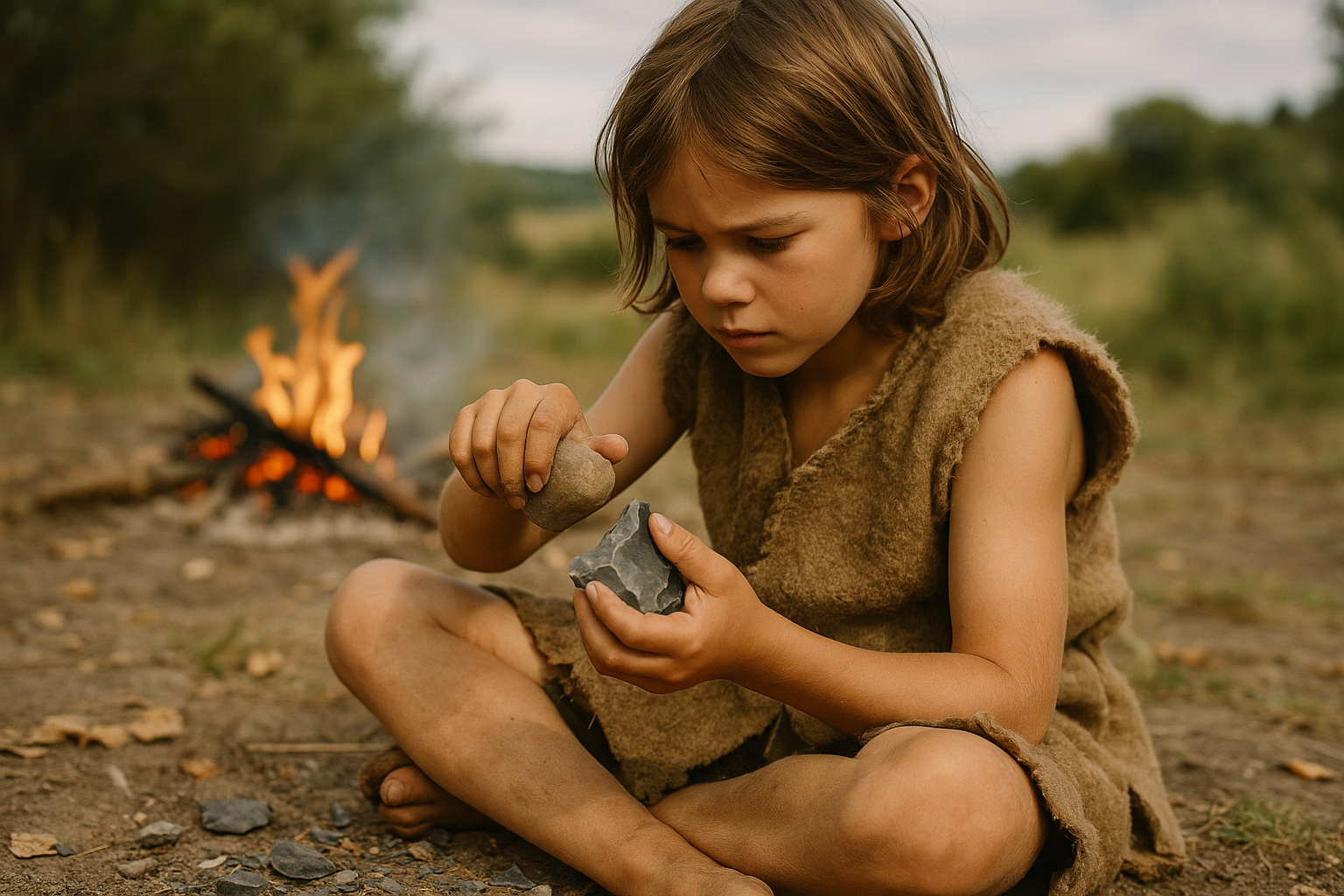
The Boxgrove workshop revealed that Stone Age kids weren’t just playing with rocks. By 7, they were expected to know which types of flint worked best for different tools. They could identify the perfect striking angle by sound and feel. They understood that if you heated certain stones first, they became easier to work with. It was daily, hands-on education that started from the moment children could hold a stone.
You could share details with your Key Stage 2 class like:
Stone Age Morning Routines Were Surprisingly Complex: Before breakfast, Stone Age children had real responsibilities. They might check animal traps set the night before, gather kindling for the fire, or fetch water from the nearest stream. Unlike modern children who might struggle with making their bed, Stone Age 6-year-olds were contributing essential survival tasks to their family group. When you tell primary students that prehistoric children their age were trusted with jobs that kept everyone alive, something clicks. Suddenly, Stone Age people aren’t distant historical figures. They’re capable kids who had important roles.
Learning Was Constant and Hands-On: Stone Age children didn’t sit in classrooms learning abstract concepts. They learned by doing, watching, and practicing. A 5-year-old might spend hours watching an adult make a hand axe, then practice on their own small stones. By 8, they’d be crafting simple tools themselves. By 10, they could create sophisticated hunting equipment. This resonates powerfully with primary school students who often struggle to see the point of traditional classroom learning. Stone Age education was immediately practical, visibly important, and resulted in tangible skills.
Daily Life Required Incredible Knowledge: Every Stone Age person needed to be a botanist (knowing which plants were safe to eat), a zoologist (understanding animal behaviour for hunting), a geologist (identifying the right stones for tools), a meteorologist (predicting weather for survival), and an engineer (building shelters and creating tools). When you break down the sheer volume of knowledge required just to survive one day in Stone Age Britain, primary students develop massive respect for our ancestors’ intelligence.
Children Had Real Status and Responsibility: Unlike today where kids are often told to “stay out of the way,” Stone Age children were valued contributors. A child who spotted animal tracks might lead the adults to a successful hunt. A young person who crafted a particularly good hand axe would earn respect from the whole group. This detail fascinates modern children who sometimes feel their contributions don’t really matter. Stone Age kids mattered. Their skills, observations, and work were essential.
What Makes Stone Age History Engaging for Key Stage 2
The real genius of teaching Stone Age daily life details is that every fact reveals how different yet similar our ancestors were. Stone Age parents worried about their children’s education, just like modern parents. They celebrated when kids mastered new skills. They probably argued about bedtime and chores. They told stories, played games, and had family routines.
When primary schools move beyond “Stone Age people hunted mammoths” to explore the actual daily experiences of Stone Age children, something powerful happens. Students start asking questions. “How did they wake up without alarm clocks?” “What happened if a child didn’t want to learn tool-making?” “Did they have best friends?” These aren’t questions about dates and periods. These are questions about human experience, which is exactly what makes history compelling.
This becomes even more powerful when students can actually interact with someone from that time period. Imagine your Year 3 class being able to ask a Stone Age child directly: “What did you eat for breakfast?” “What was your favourite game?” “Were you scared of wild animals?” When history becomes a conversation rather than a lecture, when students can hear about daily Stone Age life from someone who lived it (or in this case, a character who represents that experience), abstract facts transform into vivid reality.
The Secret to Making Stone Age Britain History Unforgettable
That’s not just curriculum delivery. That’s showing children that people 10,000 years ago weren’t alien or incomprehensible. They were humans with daily routines, family relationships, fears, joys, and challenges. They just happened to need completely different skills to navigate their world. And those skills, from fire-starting to tool-making to animal tracking, are endlessly fascinating to primary school students who increasingly live in a world where survival skills have been replaced by screen skills.
Just like the Boxgrove discovery proved, when you examine the daily details rather than just the big picture, you discover that Stone Age people were far more sophisticated, skilled, and relatable than we ever imagined. And that revelation transforms how children think about history, about human capability, and about their own potential.
Speaking of bringing Stone Age daily life into vivid focus for primary students, I’ve discovered history workshops that do something truly extraordinary. They let your students actually talk to a Stone Age child and ask all those burning questions about prehistoric life. You know how we’re always looking for ways to make ancient history feel immediate and real rather than distant and abstract? Well, meeting Taki transforms Stone Age history from something children read about into someone they can actually get to know.
Taki’s Stone Age Journey Workshop
Meet Taki: Your Students’ Guide to Prehistoric Britain
Step into the past with Taki, an 11-year-old Stone Age child who becomes your students’ personal guide to life 10,000 years ago. This isn’t a lecture about the Stone Age. This is an immersive, interactive journey where primary school children discover what daily life was really like through the eyes of someone who lived it.
Through cutting-edge character technology, Taki comes to life in your classroom, ready to answer questions, share stories, and reveal the fascinating details of Stone Age childhood that textbooks simply can’t capture. Students don’t just learn about prehistoric Britain. They meet someone from that world.
How This Interactive Stone Age Workshop Works
Real-Time Conversations with a Stone Age Child
The magic begins when Taki appears and your students realize they can actually talk to someone from 10,000 years ago. They can ask anything:
“What did you eat for breakfast this morning?” “How did you learn to make fire?” “What’s the scariest animal you’ve ever seen?” “Do you have friends? What games do you play?” “What happens if you don’t want to go hunting?”
Taki responds in real-time, sharing vivid details about daily Stone Age life that bring prehistoric Britain to startling life. Suddenly, history isn’t about memorizing facts. It’s about understanding a real person’s experiences, challenges, and daily adventures.
Immersive Storytelling and Interactive Challenges
Beyond conversation, Taki takes students on a thrilling classroom adventure filled with:
Mystery and Problem-Solving: Something has gone wrong in Taki’s Stone Age village, and your students need to help solve it. Working together, they’ll use their growing knowledge of Stone Age life to uncover clues and resolve the mystery.
Hands-On Stone Age Skills: Students don’t just hear about Stone Age techniques. They try them. From identifying tools to understanding survival strategies, children engage with practical challenges that Stone Age children mastered daily.
Authentic Daily Life Details: Through Taki’s stories and experiences, students discover the real texture of prehistoric life. How families worked together. What children’s responsibilities were. How people stayed warm, found food, and entertained themselves without any modern technology.
Curriculum-Aligned Learning: Every element connects directly to Key Stage 2 history curriculum requirements, covering Stone Age to Iron Age Britain, changes in daily life, and technological advancement, all delivered through engaging narrative rather than dry facts.
Why This Primary School History Workshop Transforms Learning
Makes History Personal and Relatable: When students meet Taki, Stone Age people stop being abstract historical figures and become relatable children with fears, friendships, and family responsibilities. This personal connection creates memories that last far beyond the lesson.
Answers the Questions Students Actually Have: Traditional teaching tells students facts about the Stone Age. Taki’s Journey lets them ask the questions they’re genuinely curious about. The difference in engagement is remarkable. When children drive the learning through their own curiosity, retention skyrockets.
Brings Daily Life into Sharp Focus: Through conversation with Taki, students discover the daily life details that make history fascinating. Not just “Stone Age people made tools” but “Here’s why I spent three hours yesterday learning to chip flint, and my fingers still hurt.”
Supports Different Learning Styles: Visual learners engage with Taki’s appearance and the immersive environment. Auditory learners thrive on the conversation and storytelling. Kinesthetic learners participate in the interactive challenges. Every child finds their way into the learning.
Creates Classroom Buzz: Students don’t just remember the Stone Age unit. They remember the day they talked to Taki. They go home and tell their families about their new Stone Age friend. That enthusiasm transforms classroom culture around history learning.
Flexible and Adaptable: Perfect for Key Stage 2 classes, the workshop adapts to different year groups and can be tailored to specific curriculum focuses or school timetables. Whether you’re introducing the Stone Age topic or deepening existing knowledge, Taki’s Journey enhances your teaching.
Available Across the UK and Ireland
These Stone Age workshops bring everything needed to transform your classroom into prehistoric Britain. Professional facilitators guide the experience, ensuring curriculum objectives are met while students remain fully immersed in Taki’s world. Your students won’t just learn about the Stone Age. They’ll meet someone who lived it, ask their burning questions, and discover that history is full of real people whose daily lives were far more fascinating than they ever imagined.
Bring Taki to Your Classroom
Ready to give your students an unforgettable Stone Age experience? Discover Taki’s Stone Age Journey workshop and transform your history curriculum into an interactive adventure. Available across the UK and Ireland, this immersive experience turns passive learning into active discovery, creating the kind of educational moments students remember for years. Just like those Boxgrove craftspeople spent years mastering their skills, your students will spend this session mastering something equally valuable: the art of asking great questions and discovering that history is full of people just like them.