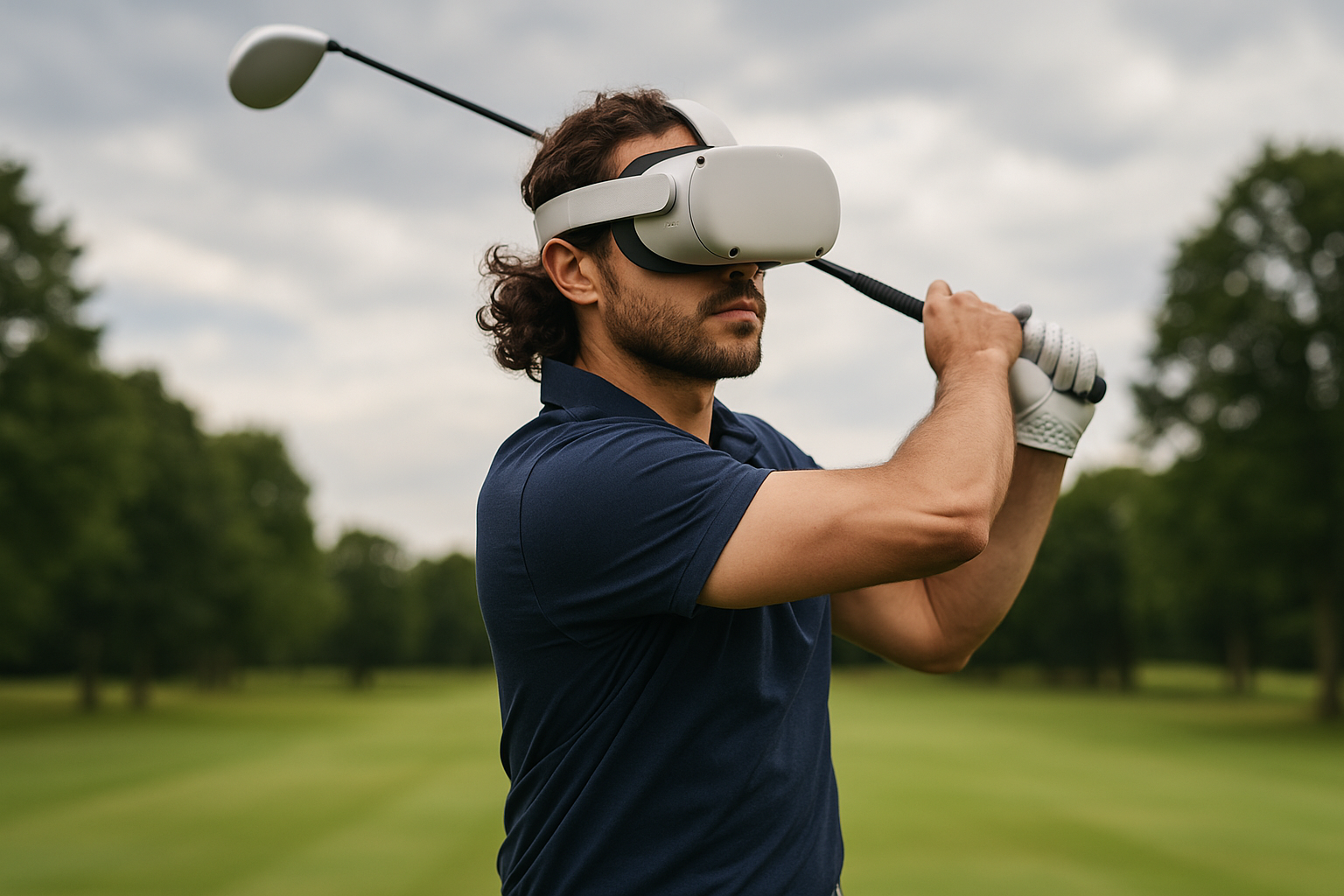
There’s a behind-the-scenes clip of the European Ryder Cup team—world-class golfers prepping for battle. But it’s not just stretching and swing drills. They’re inside virtual reality, using it to rehearse shots, relive pressure scenarios, and fine-tune decision-making in moments you can’t exactly “recreate on a school field on Tuesday.”
Why? Because immersive tech builds skill. Builds confidence. Builds the mindset it takes to perform—whether you’re teeing off in front of a global audience or stepping into your first PE class.
If elite athletes trust VR to get better, imagine what it could do for kids.
Sport Tech Is Getting Real—For Real People
But VR and AR can be for more than just for elite teams like the Ryder Cup squad. They’ve quietly moved into schools, clubs, and classrooms because they solve a problem traditional coaching can’t.
They let you:
Practice when it’s raining.
Train without a perfect pitch.
Learn through doing, not just listening.
When sport feels like a game—not a test—kids give you full effort, full attention, and full joy. That’s the difference.
How can this Ryder Cup Pressure story relate to Primary School children?
The European squad used VR to simulate heckling crowds and high-stakes moments. But here’s what children need more than anything: a safe space to fail, try again, and grow.
Immersive environments can:
Remove the fear of embarrassment
Let students progress at their own pace
Offer instant feedback and reward effort
Build small wins that feel big
For a lot of children, especially those on the edge of disengagement, sport becomes real when it feels achievable. That’s what immersive tech delivers.
Here’s a real example: Giant Journeys VR Sport Experience
A very powerful classroom tool is the Giant Journeys VR Sport workshop, a fully immersive experience that lets children step into Olympic-inspired challenges.
They’re not watching sport. They’re inside it.
As well as working outside of VR in sports, they also experience an Opening Ceremony and others films showing the experts perform. They try new skills. Some may have not watched the Steeplechase, BMX racing, Fencing or High Diving They experience this at first hand and also how teamwork can really make a difference.
And all of it happens in a world that feels more like a mission than a lesson.
How VR Builds a Deeper Understanding of Sport
We can tell kids about reaction time, or we can let them feel it in a VR sprint challenge.
For example, we can explain why athletes visualise routines, this isn’t just gamified PE. It’s cognitive training. VR and AR are building:
Spatial awareness
Pattern recognition
Timing and rhythm
Real movement confidence
It’s not a gimmick. It’s a tool for real-world readiness.
Bring Sport Science to Life with the Around the Body VR Journey
Want to take it one level deeper? The VR Around the Body Workshop shows children what movement looks like from the inside. They explore muscles, breathing, and biomechanics in a way no poster or textbook ever could.
Suddenly, they’re not just moving. They understand why they move the way they do. And that kind of knowledge changes how a child sees themselves in sport.
Sporty or not, this gives them a reason to lean in. To try. To care.
If the best athletes in the world are using immersive tech to get 1% better, what could it do for the 11-year-old who’s never felt confident in PE?
This isn’t about gimmicks. It’s about giving every child the chance to feel like they belong in sport.
That changes everything!