Did you know there’s a space problem so embarrassing that NASA spent millions trying to solve it, but your Year 4 students will find it absolutely hilarious?
Picture this: It’s March 1965, and astronaut John Young is about to make history on Gemini III, America’s first two-man space mission. He’s trained for years, undergone countless tests, and is representing the pinnacle of human achievement. So naturally, his biggest concern is… lunch.
You see, NASA’s space food was absolutely revolting. We’re talking freeze-dried cubes that tasted like cardboard and tubes of “beef and vegetables” that looked like dog food. Young took one look at this culinary nightmare and thought, “Not on my watch.”
So what does this decorated test pilot, this hero of the space program, do? He smuggles a corned beef sandwich from Wolfie’s Restaurant in Cocoa Beach into his spacesuit pocket.
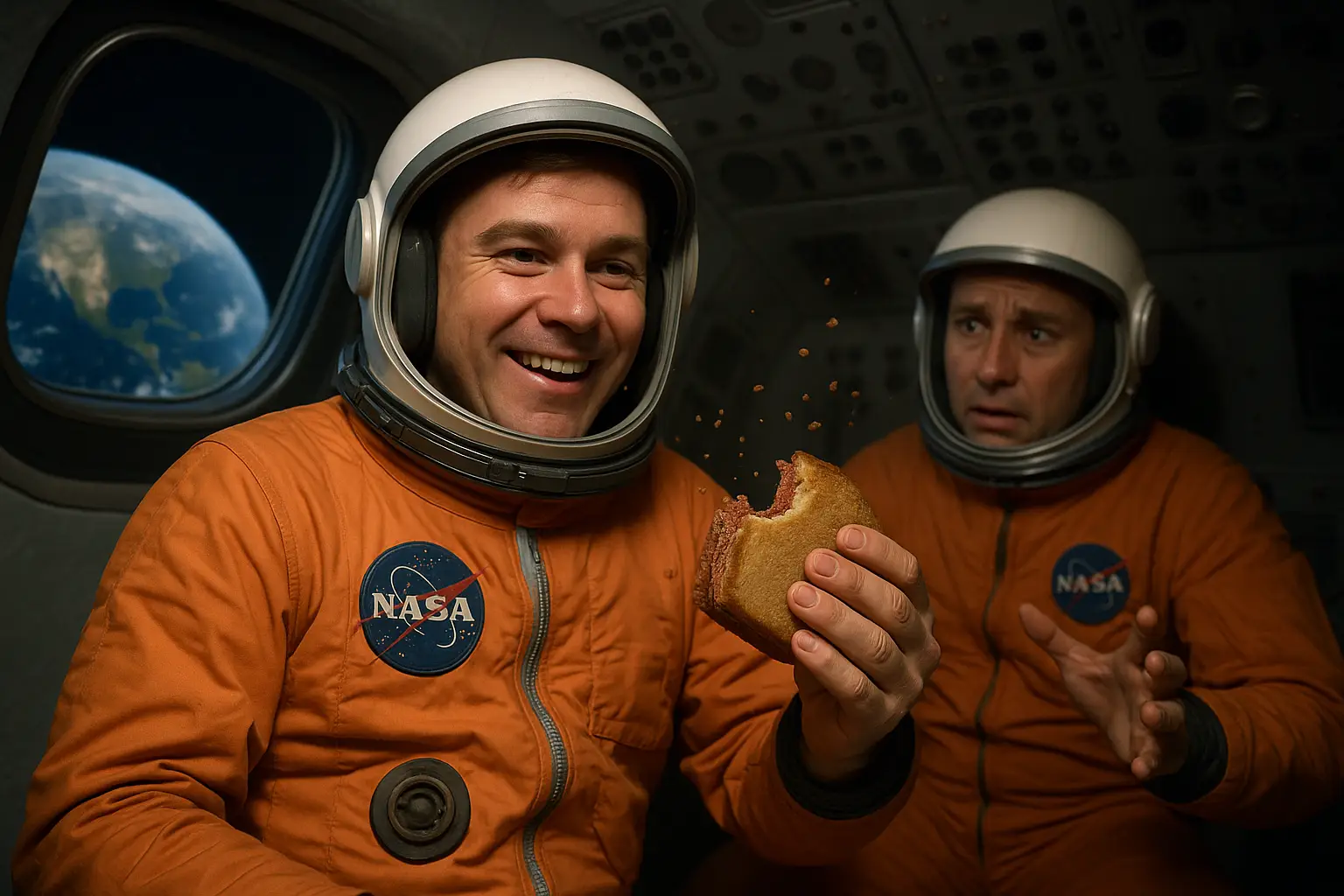
Mid-flight, 100 miles above Earth, Young casually pulls out his contraband sandwich and offers it to his crewmate Gus Grissom with a cheeky grin. Grissom takes a bite, and immediately the capsule fills with floating crumbs. Not cute little crumbs—we’re talking about potentially mission-ending debris that could clog air filters, damage equipment, or get inhaled by the crew.
Grissom quickly wraps up the sandwich, muttering something about getting in serious trouble, while Young just shrugs like he’s sharing his packed lunch at school.
But here’s where it gets absolutely bonkers: When NASA found out, they went ballistic. This $7 million sandwich became front-page news. Congress held actual hearings about it. Senators demanded answers about “unauthorized corned beef in space.” The most powerful space agency in the world was brought to its knees by a deli sandwich.
The best part? Young never apologized. Years later, he said it was worth it because NASA’s food was “terrible” and somebody needed to make a point. His little act of rebellion led to completely redesigned space meals that were actually edible.
That sandwich taught NASA something crucial: if you want people to perform extraordinary feats, don’t forget they’re still human beings who want a decent meal. Sometimes the smallest acts of rebellion create the biggest changes.
You know what’s brilliant about Young’s sandwich rebellion? He didn’t become less of a hero because of it—he became more relatable. That floating crumb disaster made him human, and suddenly this impossibly accomplished test pilot became someone you could actually imagine having a laugh with. It got me thinking about how we teach kids about space exploration, and I realized we’re missing the comedy goldmine that makes astronauts absolutely fascinating.
Here’s what nobody tells you about astronauts: they spend half their time dealing with problems so ridiculous that your students will be in stitches, yet we keep pretending space travel is all serious science and heroic moments.
Take the infamous “floating poo incident” of Apollo 10. Halfway to the moon, the crew discovered mysterious brown blobs floating around their capsule. The transcript (which NASA tried to keep classified) shows three grown men, trained for years, having a heated debate about whose fault it was while trying to catch runaway excrement with napkins. Commander Tom Stafford’s exact words? “Give me a napkin quick. There’s a turd floating through the air.”
Or consider the “Great M&M Chase” that happens on every space station mission. Astronauts regularly lose entire meals to zero gravity—cookies crumbling into floating clouds, M&Ms ricocheting off walls like tiny colorful bullets, orange juice forming perfect floating spheres that stick to everything. They spend hours each week literally chasing their food around like they’re playing the world’s most expensive game of catch.
And don’t get me started on space sneezes. When astronauts sneeze in zero gravity, the mucus doesn’t fall down—it forms a floating bubble that hovers in front of their face until they wipe it away. Imagine trying to explain that with a straight face to mission control.
But here’s the kicker: when you tell kids these stories, something magical happens. Suddenly, astronauts aren’t untouchable superhumans—they’re people who deal with the same gross, funny, everyday problems as everyone else, except theirs float around in zero gravity. That’s not just space education—that’s pure engagement gold that makes kids desperate to learn more.
Speaking of making space exploration hilariously real for kids, I’ve discovered something that takes this exact approach to the next level. You know how we’re always looking for ways to make space feel tangible and exciting rather than impossibly distant? Well, there’s this incredible VR workshop that lets your students actually experience the chaos and wonder of space travel—floating food disasters, zero-gravity mishaps, and all.
Giant Journeys Space VR Workshops
Step into a spaceship and blast off on an unforgettable virtual reality adventure that brings space exploration directly into your classroom. Students don VR headsets and find themselves aboard the International Space Station, experiencing the wonders and challenges of life in zero gravity firsthand.
This immersive 45-minute experience combines cutting-edge VR technology with curriculum-aligned content, allowing pupils to conduct experiments, navigate spacecraft, and solve real astronaut problems while floating in zero gravity. Perfect for Key Stage 2 and above, students work in teams to complete space missions while learning about physics, engineering, and the realities of space travel.
What makes this special:
- Students experience actual astronaut training scenarios
- Interactive problem-solving with floating objects and zero-gravity challenges
- Curriculum-aligned content covering space exploration, physics, and STEM subjects
- Professional facilitators guide the experience and debrief with educational insights
- Available across the UK and Ireland with all equipment provided
Your students won’t just learn about the problems astronauts face—they’ll experience them firsthand, from chasing floating objects to navigating spacecraft. It’s like giving them a taste of John Young’s corned beef sandwich adventure, but without the congressional hearings!
Finally, here’s something that’ll blow your mind: NASA actually has an entire department dedicated to studying astronaut bathroom habits, and they’ve spent over $23 million perfecting space toilets since the 1960s. The current space station toilet cost $19 million and still malfunctions regularly, leading to “emergency protocols” that involve floating waste and panicked astronauts with wet wipes. But here’s the really wild part—when astronauts talk to kids about space, the number one question is always “How do you go to the toilet up there?” followed by uncontrollable giggling. NASA finally realized that embracing these “embarrassing” topics isn’t unprofessional—it’s the secret to inspiring the next generation of space explorers. Sometimes the best way to reach for the stars is to start with what makes us all human.